Tectonic plates in Iceland: where to see them
Þingvellir is the best place to see the plates, Silfra the best place to be inside the rift, and the Bridge Between Continents is a ten-minute photo stop.
The short version
- The plate boundary is not a single crack. It is a rift zone tens of kilometres wide, running across Iceland from Reykjanes to the northeast.
- Þingvellir shows it best: the Almannagjá cliff is the edge of the North American side, and the valley floor is sinking.
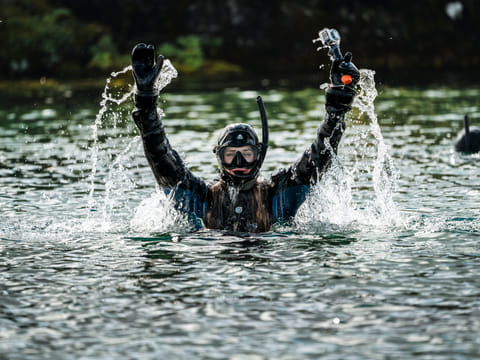
- In Silfra you snorkel or dive inside a rift fissure. Minimum age is 12 for snorkelling, and diving needs a drysuit certificate.
- The Bridge Between Continents on Reykjanes is a short footbridge over a sandy rift, about 20 minutes from Keflavík airport.
Go to Þingvellir. It is the place where the gap between the North American and Eurasian plates is easiest to see and best explained, and it is on every Golden Circle tour. If you want to be inside the rift, snorkel Silfra. The Bridge Between Continents on Reykjanes is fun for ten minutes on the way to the airport, but nobody should plan a day around it.
What you are actually looking at
The two plates are pulling apart by about two centimetres a year, and Iceland sits on top of the seam. But the boundary is not a single crack you can step over. It is a rift zone tens of kilometres wide, full of parallel fissures, faults and young volcanoes, running from the tip of Reykjanes through Þingvellir and the Highlands to Mývatn and the northeast.
So every “stand between two continents” spot is a little symbolic. You are standing in the zone where they separate, not with one foot on each. That is no reason to skip them. It is a reason to pick the place where you can actually see the thing happening.
Þingvellir: the best view of it
At Þingvellir the rift is the whole landscape. You walk down through Almannagjá, a long gorge whose western wall is the edge of the North American side. Across the valley, several kilometres east, Hrafnagjá is the matching fault on the other side. The ground in between has dropped, and it is still dropping. Þingvallavatn, the biggest lake in Iceland, fills the low ground.
It is also where Iceland’s parliament met from about 930, which is why it is on the UNESCO list. An hour is enough to walk the gorge and see the old assembly site. Our Þingvellir guide goes further.
You do not need a special tour. BusTravel Iceland’s Grand Golden Circle Tour is from €88 for eight and a half hours, with Þingvellir as the first stop.
Silfra: inside the rift
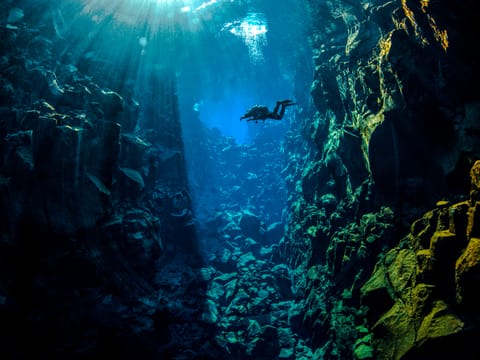
Silfra is one of the fissures at Þingvellir, filled with glacial water that has filtered through lava for decades. It is about 2 to 4°C and extremely clear. You float through it in a drysuit, with rock walls on both sides dropping into blue.
Arctic Adventures’ Into the Blue - Silfra Snorkeling is from €121, three hours, meeting at Þingvellir, and shows dates on most days of the year. The minimum age is 12. Deep Into the Blue - Silfra Diving is from €245, adults only, and needs a drysuit certificate or ten logged drysuit dives. For most people snorkelling is the better choice. Our Silfra guide explains why.
The downside is the cold. Your hands and face feel the water within minutes, and in winter you change in the car park in the wind.
The Bridge Between Continents
On the west side of Reykjanes, at Sandvík on Route 425, a short footbridge crosses a sandy rift. A sign tells you that you are walking from Europe to North America. It takes ten minutes, it is free, and it is about 20 minutes from Keflavík airport.
It is honestly a photo stop. The gully is filled with sand, so there is not much to see underneath. It works best on the drive to or from the airport, with Gunnuhver and the Reykjanes lighthouse nearby. Our Reykjanes by car guide puts it in a loop.
Without a car, Glaciers and Waterfalls’ Volcano Circle Tour is from €110 for seven hours from Reykjavík, with the bridge, Grindavík, Kleifarvatn and the hot springs. Its calendar is patchy, so check dates first.
In the north
Near Mývatn the same rift zone shows up again, in the cracks at Stóragjá and Grjótagjá and in the lava fields around Krafla. If you are going north anyway, it is worth knowing you are in the same rift. It is not worth a trip on its own. Our Mývatn day tour guide covers the area.
Our honest take
Þingvellir first, every time. It is free apart from parking, it is on the way to Geysir and Gullfoss, and it is the one place where the rift makes sense when you look at it.
If you are twelve or older and can stand cold water, add Silfra snorkelling. It is the best way to feel the rift rather than just look at it. Treat the Bridge Between Continents as a bonus on the way to the airport, not a reason to go to Reykjanes.