Whale watching in Iceland month by month, including January and November
Which harbours sail in which months, what you can realistically expect to see in winter, how the free retry ticket works, and honest sighting odds.
Yes, you can see whales in Iceland in January. Yes, in November too. The animals do not leave; the boats and the daylight do. What changes month by month is which harbour is sailing, how long the trip is, and how much sea you are prepared to sit in.
We list 90 per-person whale tours from 19 operators. The median is €136 and the cheapest real boat trip is around €82.
The one thing that decides everything: which harbour
Reykjavík’s Old Harbour sails all year. Faxaflói bay is shallow, sheltered by the peninsula on both sides, and the feeding grounds are close enough that a three-hour trip reaches them in any month. That is why every winter whale tour in this country leaves from there or from Akureyri.
Eyjafjörður in the north — Akureyri, Dalvík, Hauganes, Árskógssandur — also sails through the winter, from a long fjord that stays workable when the open sea does not. Húsavík, the harbour with the reputation, is a summer operation: the bay it fishes is open to the Arctic and the boats largely stand down from late autumn.
So: all year, Reykjavík or Eyjafjörður. April to October, add Húsavík.
April to June
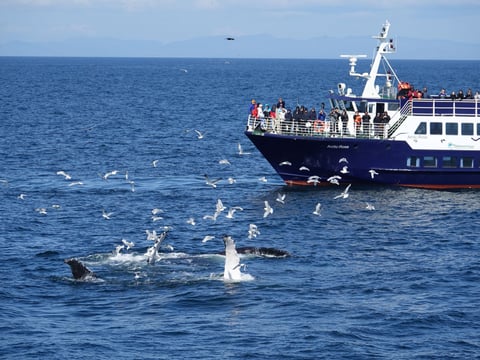
The best months, and few people book them. Humpbacks and minkes arrive with the herring and capelin, the sea is calmer than in winter, and Húsavík opens. North Sailing’s Húsavík Original Whale Watching is €100 for three hours on a wooden boat — the tour that built the town’s name. Arctic Adventures’ Classic Whale Watching from Dalvík is €85, the cheapest northern trip we hold.
Puffins are ashore from roughly May, so a combined trip out of Reykjavík or Hauganes gives you two things for one boat.
July and August
Peak sightings and peak everything else. Boats are full, harbours are busy, and prices are at their highest. Whale Watching Hauganes’ 100% Whale Watching at €90 for two and a half hours is the kind of small-operator trip worth choosing over a full 150-seat boat in high season.
Midnight-sun sailings run in June and July, which is a genuinely different trip: same bay, low orange light, no crowding on deck because the departure is late.
September and October
Our quiet recommendation. The whales are still feeding, the boats are half empty, the northern lights season has started so the same trip can be paired with an evening out, and the prices soften. Húsavík is still sailing in September and tapering through October.
November to March
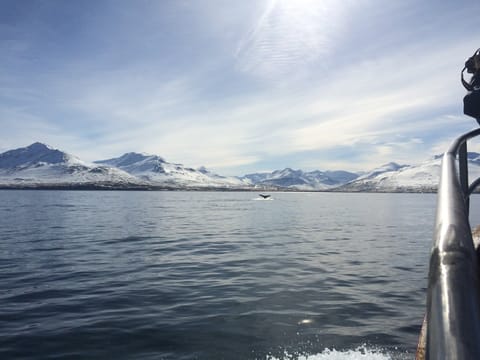
This is where the honest part matters. Winter sightings in Faxaflói are dominated by white-beaked dolphins and harbour porpoises, with minke and the occasional humpback. Big whales are less frequent than in June. Nobody can promise you a humpback in January, and an operator who does is selling weather.
What you get instead: a cheaper boat, a nearly empty deck, and a bay in winter light. Elding’s Reykjavík Classic Whale Watching runs all year at €103 including pickup, and Iceland Discover’s Whale Watching and Marine Life Tour in Faxaflói is €82 from downtown.
Two practical things. Daylight is the limit: in December and January there is one sensible departure window, around the middle of the day, so build the rest of that day around it. And the sea is bigger. If you are prone to seasickness, take the tablet before you board, not when you feel it.
The free retry ticket
Most Reykjavík and Eyjafjörður operators issue a free retry ticket if no whales or dolphins are seen on your trip. It is the single reason winter whale watching is less of a gamble than it looks — but it only has value if you are still in the country the next day. Book early in your stay, not the morning of your flight home.
Separately, boats cancel for wind. That is a refund or a new date, not a retry ticket. How that works across operators is in our cancellations guide.
Honest odds
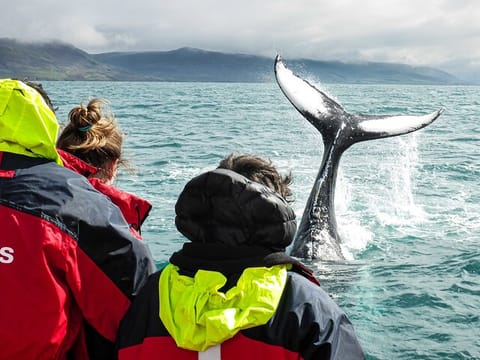
Operators publish sighting rates in the nineties for summer and most are telling the truth, because a dolphin counts. If your question is “will I see a whale”, summer is a strong bet and winter is a coin-toss weighted in your favour by the retry ticket. If your question is “will I see a humpback breach”, nobody can answer that in any month.
Our honest take
June to September, go from Húsavík or Dalvík if you are anywhere near the north — smaller boats, better bay, and it is what the region does. From Reykjavík, any month, the €82–€104 three-hour trips are the same bay on different hulls; pick by departure time and whether you want hotel pickup.
In January or November, go, but treat it as a boat trip in winter light that may include a whale, and keep the retry ticket. If seeing a large whale is the whole point of your trip and you are here in midwinter, we would rather you spent the €100 on something the season actually favours — an ice cave or a northern lights night — and came back in June.
More context: Reykjavík versus Húsavík, whale watching in winter, and what the category costs on our whale price page.