Katla's ice cave is the practical pick; the crystal caves are the prettier one
Katla ice cave near Vík versus the Vatnajökull crystal caves at Jökulsárlón. Season, how you get in, what the ice looks like, and which suits your trip.
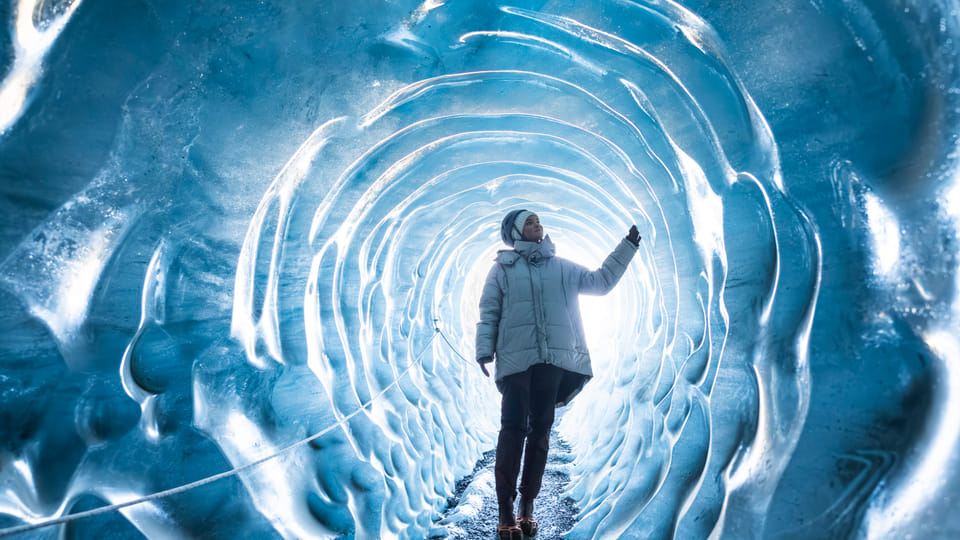
Iceland sells two kinds of ice cave. Both are real caves in real glaciers, and both are worth doing. They’re in different places, they look different, and they suit different trips. Pick by geography first and colour second.
Katla: ash-striped ice, reached from Vík in a super jeep
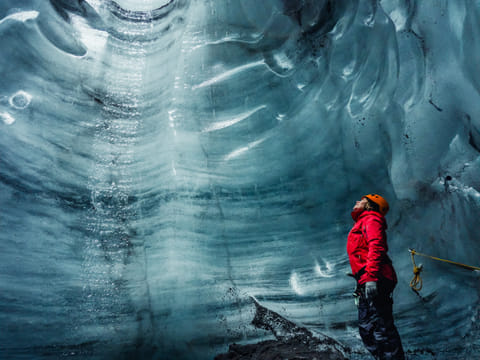
The Katla cave is under Kötlujökull, an outlet of the Mýrdalsjökull ice cap, which sits on top of the Katla volcano. You reach it from Vík: a super jeep drives you across the black outwash plain and up to the glacier’s edge, then you walk in on crampons. The ice is layered with volcanic ash, so instead of clear blue you get bands of black and grey through white and blue, like sediment in a cliff. Parts of it are open to the sky. It’s dramatic in a different way from what the brochures show.
Arctic Adventures runs Katla Ice Cave & Super Jeep from Vík, three hours from €213, meeting in Vík. That’s the one for self-drivers staying on the South Coast. From Reykjavík, the same operator’s Katla Ice Cave & South Coast Tour makes it a 12-hour day from €256, with the waterfalls and Reynisfjara on the way. BusTravel Iceland’s South Coast & Katla Ice Cave is the equivalent, 11 hours from €256.
The practical advantage: Vík is two and a half hours from Reykjavík, not five. The cave can be done as part of an ordinary South Coast day. The departures we list run through the winter season.
Downsides: the ash makes it darker inside, and the shape changes with meltwater; some years the cave is a long tunnel, some years a short one. Nobody can tell you in advance what you’ll get.
Vatnajökull crystal caves: blue, brief, and far
The crystal caves form under Breiðamerkurjökull near Jökulsárlón, about five hours east of Reykjavík. Meltwater carves tunnels through the glacier in summer; when the water drops and the ice freezes solid in late autumn, guides go in and check them. The season is roughly mid-November to March. Before that they’re wet and unstable. After that the roof softens.
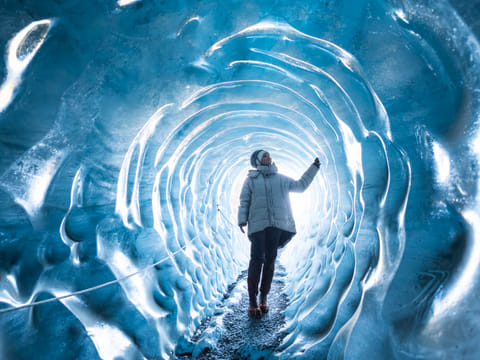
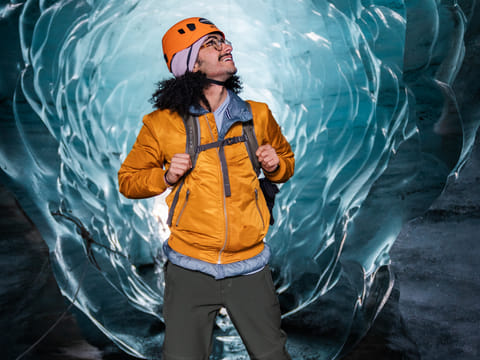
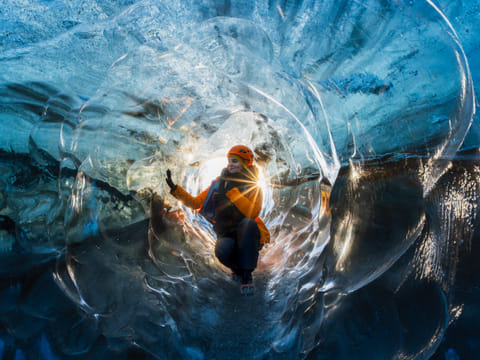
Inside, the ice is dense and clear enough to glow blue with the daylight coming through the glacier above. That’s the photograph everyone has seen, and yes, it looks like that on a good day.
Arctic Adventures’ Crystal Ice Cave Tour meets at the Jökulsárlón car park, two and a half hours from €155, with a super jeep run up onto the glacier and a short walk in. It’s the cheapest cave on our list, but you have to be at Jökulsárlón to take it, and that means either a multi-day tour or a car and a bed in the southeast.
Downsides: crowds inside a small space; caves change every year and can close mid-season if the ice shifts; and the light matters. A flat grey sky gives you flat grey ice.
“The Crystal Cave” is a description, not an address
There is no single cave called the Crystal Cave. The name attaches to whichever clear-ice cave under Breiðamerkurjökull the guides have found and checked that season — it moves, it changes shape, and the one photographed for last year’s brochure may not exist this year. Operators keep the name because it is what people search for. That is fair enough, but it means you cannot book “the” crystal cave; you book a guided trip to whatever this winter’s crystal cave is.
Ask the operator what they are currently running if the photograph matters to you. Most will tell you plainly.
Natural cave or ice tunnel — they are different purchases
Three things get sold as “ice caves” in Iceland and only one of them is a natural cave.
A natural glacier cave is the Katla and Vatnajökull tours above: meltwater-carved, seasonal, weather-dependent, reached by super jeep and crampons.
An ice tunnel is Into the Glacier on Langjökull — dug by machine, lit, fitted with handrails, open all year, and reached by a glacier truck from Húsafell or Klaki base. It is genuinely impressive and it is engineering, not geology. It also costs more than either natural cave. We compared it with the lava tube version in Lava Tunnel versus Into the Glacier.
An indoor ice cave is the one built inside Perlan in Reykjavík. It is a museum exhibit, it is excellent for children and for a wet afternoon, and nobody should book it thinking they have been on a glacier.
If you are travelling between April and October, the tunnel and the exhibit are your only options, and saying so is more useful than selling you a summer “ice cave” that is really a tunnel.
The window is roughly mid-November to March
Natural cave season is short and it is set by temperature, not by the calendar. The caves fill with meltwater through the summer; the water drops and the roof freezes solid in late autumn; guides then walk in, inspect, and open what is safe. That is usually mid-November. By late March the roof is softening again and tours stop.
Every operator publishes slightly different dates because every operator is looking at a different glacier. Trust the booking calendar over any month named in a description.
Why a cave closes at a day’s notice
Four reasons, all of them good ones.
Warm weather. A few days above freezing and meltwater starts moving through the ice again. The roof is the risk.
Rain. Same mechanism, faster.
The river. Most caves are entered along or across a glacial river bed. The river rises, the entrance is cut off, and the cave is fine but unreachable.
The glacier moved. Ice flows. A cave that was a twenty-metre chamber in December can be a closed crack in February.
Operators cancel rather than take the chance, and you get a refund or another date — see how tour cancellations work. The practical consequence is that an ice cave should not be the last thing you do before flying home. Put it in the middle of the trip so there is room to rebook.
Our honest take
If you’re based in Reykjavík with three or four nights and no car, do Katla. It fits inside a South Coast day, you see the waterfalls and the beach on the way, and the ash-banded ice is worth seeing in its own right. That’s the practical answer.
If you’re already going to Jökulsárlón between November and March, on a two-day tour or driving and staying in the east, do the crystal cave. It’s the better-looking cave, and at €155 it’s cheaper once you’re there.
The tradeoff: Katla asks for a day, the crystal cave asks for a trip. Don’t drive ten hours in a day for two and a half hours of blue ice. Sleep in the southeast, or take the black-and-white version and be home for dinner.